
Drywall Retexturing San Diego
Mask
Lorem ipsum dolor sit amet, consectetur adipiscing elit. Ut elit tellus, luctus nec ullamcorper mattis, pulvinar dapibus leo.
Scrape
Lorem ipsum dolor sit amet, consectetur adipiscing elit. Ut elit tellus, luctus nec ullamcorper mattis, pulvinar dapibus leo.
Skim Coat
Lorem ipsum dolor sit amet, consectetur adipiscing elit. Ut elit tellus, luctus nec ullamcorper mattis, pulvinar dapibus leo.
Sand
Lorem ipsum dolor sit amet, consectetur adipiscing elit. Ut elit tellus, luctus nec ullamcorper mattis, pulvinar dapibus leo.
Whole-room and whole-home drywall retexturing — smoothing, updating, and removing old wall and ceiling texture. Properly prepped, thin bonded skim coats, and a clean job site across San Diego County.

What is drywall retexturing?
Drywall retexturing resurfaces whole walls, rooms, and ceilings — thin skim coats applied over existing texture to build a smoother, more modern finish. It’s the right call for dated orange peel, popcorn ceilings, bad patchwork from a previous job, or walls that read rough under natural light.
Matching texture on a single patch is different work — that’s on our drywall repair page. Retexturing covers the whole surface.
Retextured to a finish, not a deadline.
EXCELLENTTrustindex verifies that the original source of the review is Google. Showed up on time, were very clean and did an amazing job fixing my torn out drywall from a repipe and then gave me a new beautiful finish on my walls. Getting a quote was so easy and the quote was very detailed. I would recommend them to my pickiest friends!Posted onTrustindex verifies that the original source of the review is Google. Professional, fast and cleanPosted onTrustindex verifies that the original source of the review is Google. We had a Home Depot shed installed and started pricing out insulation, drywall, paint, and baseboards with different contractors. It added up fast and felt like a lot to manage. When we called SGP, they just handled everything. They gave us one clear, turnkey price and took care of the whole process, which made it way easier on us. Everything turned out great, but what we appreciated most was no surprises just a smooth, straightforward job from start to finish.Posted onTrustindex verifies that the original source of the review is Google. Small job for followup to HVAC replacement . Edgar was prompt and on time and very considerate in completing the job. Would definitely use again as did a great job , cleaned up and took care of.Posted onTrustindex verifies that the original source of the review is Google. Fantastic work. Excellently done, on time, quick, and friendly.Posted onTrustindex verifies that the original source of the review is Google. Edgar from SGP drywall did a great job patching up the attic access after we had a new HVAC system installed. He was quick scheduling a time with us and also sent a reminder text the night before which I appreciate. He finished the job quickly and it looks great!Posted onTrustindex verifies that the original source of the review is Google. Edgar did a great job. He arrived on time, got the job done quickly and professionally. I highly recommend him.
Retexturing over paint is its own craft.
Retexturing isn’t just putting mud on a wall. Existing painted texture has to be prepped, bonded, and built up in thin skim coats that dry properly — or the finish can pinhole, peel, or telegraph every old flaw. This page is about whole-wall, whole-room, and ceiling retexturing across San Diego.
Retexturing isn’t mud on a wall. It’s prep, bonding, and thin skim coats that dry right.
This page covers changing, smoothing, updating, or removing texture across larger surfaces — walls, whole rooms, and ceilings. Matching texture on a small patch is repair work, and it lives on our drywall repair page.
SGP came up through real field experience — a third-generation drywall background and years finishing walls and ceilings across San Diego. Retexturing rewards that experience: knowing which compound bonds to a painted surface, how thin the first coat should be, and how long it needs to dry before the next one goes on.
The first skim coat’s only job is to bond.
— why we keep it thin
Repair, texture match, or full retexture?
Patch and texture-match: If the damage is contained — a hole, a crack, a small section that got dinged — patching and blending the texture is usually the better call. Our drywall repair page covers that work. One patch shouldn’t need a whole wall.
Full-wall or room retexture: Retexturing makes more sense when the existing texture is inconsistent across a large area, prior repairs have already broken up the pattern, you’re finishing a remodel where walls got worked over, or the surface reads rough in natural light no matter how many times it’s been painted. A full-room retexture also costs less per square foot than patching the same wall six times.
When you don’t need either: If the texture is sound and the walls look fine in natural light, paint is the next step — not drywall work. We’ll say that clearly at the walk-through.
The finish lives in the prep and the skim coats.
Heavy old texture gets knocked down first — scrape or sand the high spots so new compound has a sound surface to grab. Then thin skim coats, the right material, and real drying time between them.
The first skim coat should be thin. Its only job is to bond. Heavy coats troweled over painted texture can peel, trap dust, or pinhole later — so we build the finish up gradually instead of forcing it in one pass.
Thin skim coats, the right compound, and time to dry.
Mask
Floors, furniture, windows, and openings covered and taped off before anything starts.
Scrape
Knock down heavy texture and high spots so the surface is sound before skim coating.
Skim Coat
Thin skim coats with compound chosen to grip painted surfaces — built up gradually, never thick.
Sand
Sand between and after skim coats, checking with raking light, then leave a clean job site.
Modern walls, without chasing perfect.
Heavy orange peel, knockdown, and popcorn are on their way out. Most San Diego homeowners want smoother, calmer walls — but on an older home, dead-flat can expose every wave. The sweet spot is usually a subtle, hand-worked finish.
Thick wall textures are dying.
Hand-troweled finish
Imperfect smooth
Near-smooth modern walls
Subtle, light texture
Moving away from popcorn
Updated, calmer ceilings
Not sure what suits your home? We’ll walk the rooms, look at the light, and recommend a finish that modernizes without fighting the wall. Retexturing improves the surface and finish — it doesn’t rebuild framing or straighten structural waves.
Every texture, updated or removed.
Whether you want it gone, smoothed, or simply modernized — these are the retexturing services we handle across San Diego homes.
01 · Popcorn Ceiling Removal
Scrape off dated popcorn and acoustic ceiling texture, then refinish smooth or to a light, modern texture.
02 · Skim Coating
Multiple thin skim coats troweled and rolled over existing texture to build a smoother, calmer surface.
03 · Smooth-Wall Finish
A premium close-to-smooth, near-Level-5 look on existing walls — honest about what old surfaces allow.
04 · Imperfect Smooth
A subtle hand-worked finish that reads modern and clean while still forgiving an older wall's flaws.
05 · Hand-Troweled / Skip Trowel
Soft, hand-applied texture — a warm, custom look that's replacing heavy machine textures.
06 · Knockdown Update
Refresh tired knockdown — knock down the old, even it out, and re-lay a consistent modern pattern.
07 · Orange Peel Update
Smooth out heavy or uneven orange peel, or re-shoot a lighter, more even spray texture.
08 · Ceiling Texture Removal
Take ceilings back to smooth — or re-texture lightly — with heavy protection below and clean cleanup.
How a retexture actually runs.
The same controlled sequence every time — built so the new finish bonds, dries, and lasts instead of pinholing or peeling later.
01. Mask & Protect
Floors, furniture, windows, and openings covered and taped off before anything starts.
02. Scrape & Sand
Knock down heavy texture and high spots so the surface is sound and ready to bond.
03. Bonding Skim Coat
A thin first skim coat, rolled in multiple directions, with compound chosen to grip painted surfaces.
04. Dry
Let each skim coat dry properly — no rushing, no trapping moisture or dust under the next coat.
05. Second Skim Coat
Build the finish gradually with additional thin skim coats until the surface reads even.
06. Texture or Smooth
Lay the chosen finish — smooth, imperfect smooth, hand trowel, knockdown, or orange peel.
07. Light Check
Raking light across the surface reveals imperfections so they're caught before paint.
08. Sand & Clean
Final sanding, then full cleanup — the room left ready for primer and paint.

Why retextured walls get pores and pinholes.
Those little dots, craters, and pinholes after sanding or paint are the most common retexture complaint. They usually trace back to one thing: dust and air in the surface the compound couldn’t grip.
- Surface dust or dusty old texture under the skim coat
- Skim coating too fast, too thick, or overworking the mud
- Trapped air in texture valleys it never filled
Our fix is technique: a proper skim-coating roller (not a fiber-shedding paint roller) works material evenly into the surface and lifts fine dust — rolling in multiple directions fills the valleys instead of just dragging mud over the high spots.
A beautiful smooth look — but not new-drywall Level 5.
A true Level 5 finish is defined on properly finished new drywall, where the joints are already flat and the whole surface is skim-prepped. On an existing wall, old texture stays underneath — so we can get you remarkably close, but it won’t behave exactly like fresh board.
- A premium, close-to-smooth, near-Level-5 look
- Smoother, more modern walls and ceilings
- An improved surface — honest about what's underneath
- Not framing repair: it won't straighten waves or bowed walls
Retexturing improves the surface and the visual finish. It doesn’t rebuild structure — and we’ll tell you straight which finish will look best on your walls.
Walls often look fine until paint goes on — then raking light through a window or a single light source reveals every surface inconsistency. It’s not the paint’s fault. Afternoon sun hitting a flat wall at a low angle shows what overhead lighting hides.
That’s why we check with a raking light before primer, not after. Catching low spots, pinholes, and surface irregularities while we can still sand or skim is the difference between a wall that reads right in every light and one that doesn’t.

Why painters aren't always the right trade for texture work
Painters finish paint — they prep surfaces for paint application and apply coatings. Drywall finishers build the surface those coatings go on. The two trades overlap on minor touch-up but diverge quickly when a wall needs real skim work.
The most common call we get: “My painter retextured the wall and now it shows.” Usually the failure isn’t effort — it’s wrong material, wrong technique, or skim coats applied over a painted surface that needed bonding prep first.
If a painter finished your texture and it’s telegraphing old repairs or showing pinholes, that’s a drywall finisher’s fix. We wrote more on whether painters handle drywall repair — the short answer is: it depends on the scope.
What affects the cost of drywall retexturing?
We don’t quote fixed prices because the range is too wide — a small bathroom and a whole-house retexture don’t start from the same number. Six factors drive most estimates:
Surface area — the primary driver; more square footage means more time and material.
Occupied vs. empty — furniture, fixtures, and lived-in rooms add masking and protection time.
Ceiling height — anything above standard 8-foot adds setup time and coat reach.
Prep level — a light sand-and-skim is half the work of a full popcorn scrape.
Repairs first — bad patchwork, cracks, or water-damaged sections need correction before texture goes on.
Texture vs. smooth — close-to-smooth finishes cost more; they take more coats, more drying time, and more sanding passes.
One thing homeowners don’t expect: small rooms cost more per square foot, not less. Masking and setup is a fixed cost regardless of room size — the square footage just spreads it out. Use our drywall calculator for a rough size-and-scope estimate.
Finished walls, ready for paint.
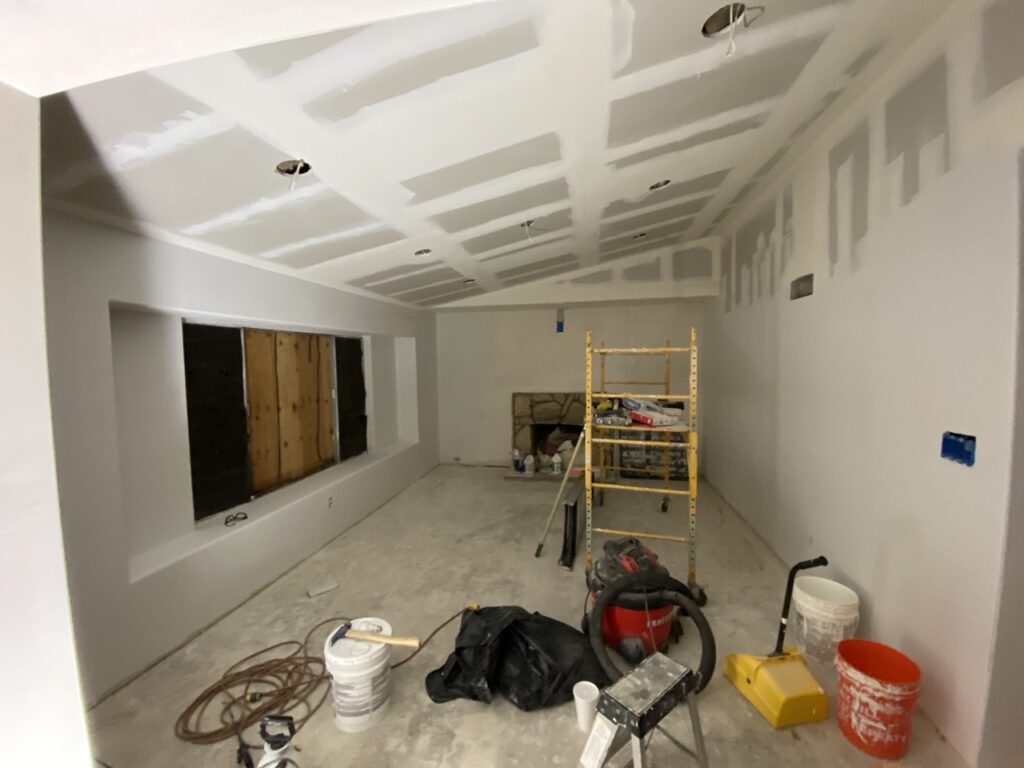
Real SGP Drywall photography across San Diego County. Smooth-wall retextures, popcorn ceiling removal, and skim coats over old texture.
 Smooth-wall retexture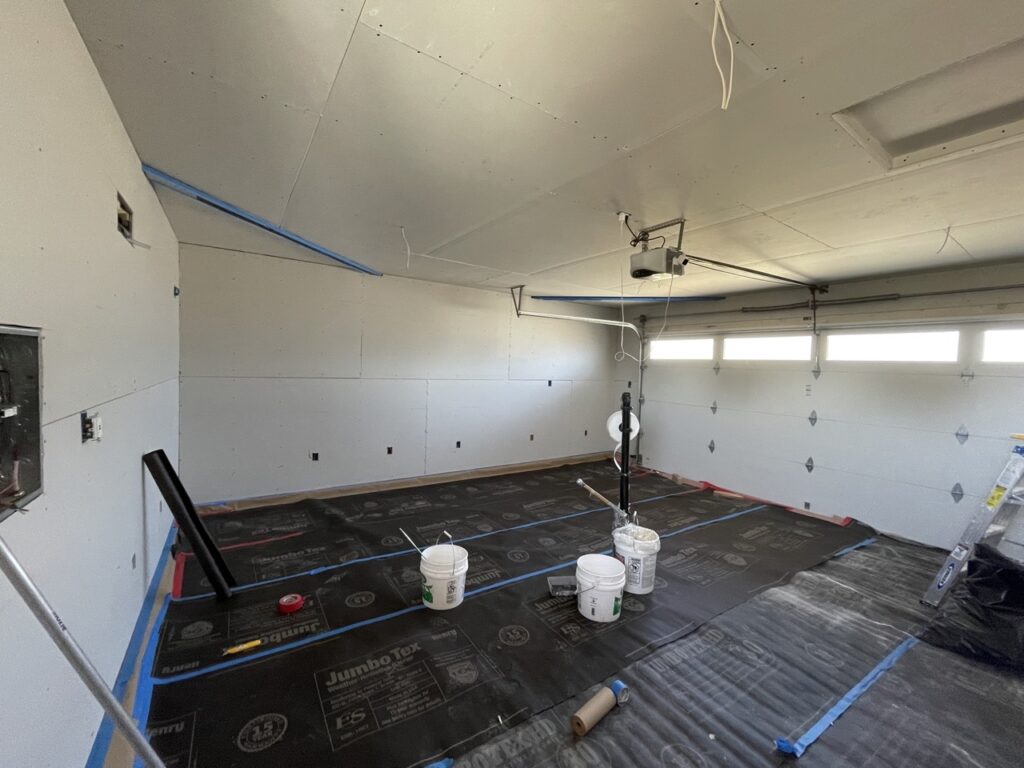
Three easy ways to get a number.
Send what you have — photos, room dimensions, or just a quick description — and we’ll come back with a clear scope.
Text photos
Snap photos of the rooms you want retextured. Photos are enough to guide a real estimate.
Send dimensions
Rough room sizes are usually enough for a ballpark — or send plans if you have them.
Request a job walk
For bigger projects, a quick walk-through is the cleanest way to scope and price.
Retexturing, answered.
Quick answers to the questions San Diego homeowners ask most before a retexture.
How much does drywall retexturing cost?
It depends on surface area, ceiling height, prep level (light scrape vs full popcorn removal), and finish type (smooth, knockdown, hand-troweled). Send photos or rough room dimensions for a real estimate.
How long does a whole-house retexture take?
Typical 3-bedroom ranges 4–7 working days including dry time. Popcorn ceiling removal adds days for protection and cleanup.
What's included in a retexturing estimate?
Masking and protection, scrape/sand prep, the right compound, multiple thin skim coats, drying time, your chosen finish, sanding, cleanup, and debris disposal.
Can you remove popcorn ceilings?
Yes. We scrape the popcorn texture off, refinish smooth or to a light modern texture, and protect the room and floors throughout.
Is popcorn ceiling removal messy?
It’s a controlled mess. We mask everything below, contain dust, and clean up fully — your floors and furniture stay protected the whole time.
Do you test old popcorn for asbestos?
Pre-1980 ceilings may contain asbestos. Testing and clearance is the work of a licensed asbestos professional — not the drywall contractor. If you’re not sure whether your ceiling has been tested, contact a licensed asbestos testing lab or consultant first. SGP proceeds after clearance is confirmed.
What finish levels do you offer?
Close-to-smooth (near-Level 5) on existing walls, plus textures — orange peel, knockdown, skip trowel, hand-troweled, and imperfect smooth.
Will my walls look exactly like new drywall?
Honestly — close, but not identical. True Level 5 lives on new drywall before paint. On existing walls we get remarkably close while honest about what old texture allows.
What's "imperfect smooth"?
A subtle hand-worked finish that reads modern and clean while still forgiving an older wall’s flaws. Popular on retextures where dead-flat would expose every wave.
Do I need to remove furniture?
We’ll move and cover what we can, but a clear room speeds the work and protects belongings. Discuss in the estimate walk-through.
How do you handle dust?
Heavy plastic and tape on floors, openings, and HVAC vents. We sand and clean in stages and leave the room ready for paint.
Is retexturing the same as texture matching?
No — they’re different scopes. Texture matching blends a repair into existing texture so the patch disappears; the goal is invisible. Retexturing replaces the surface texture across a full wall, room, or ceiling — it’s a surface rebuild, not a repair blend.
If you have a damaged section in an otherwise consistent room, drywall repair and texture matching is usually the right call. If the walls read inconsistent throughout — multiple old repairs, dated texture, or walls that need a full refresh — retexturing is the scope.
Can you skim coat over existing texture, or does it all come off?
It depends on what’s there. For light orange peel or knockdown in sound condition, we typically scrape the high points, prime, and skim over the rest — the existing surface gives the new coat something to grip. For heavy popcorn or built-up texture layers, scraping it all off gives a better substrate and more consistent results.
The condition of the surface and the finish you’re targeting determines the prep path. When we review the job we’ll tell you which approach makes sense and why.
Should I retexture the whole wall or just fix the patch?
Sometimes the patch is right scope — if the existing texture is consistent and the match holds under normal light, a skilled repair makes the area disappear. But under raking afternoon light on a large flat wall, even a good texture match can still read.
When the whole wall is a patchwork of old repairs, or the texture profile has shifted over the years, a full-wall retexture often delivers a cleaner result at a lower cost per square foot. We do both kinds of work, so we’ll give you the honest assessment — there’s no incentive to oversell the scope.
Can retexturing fix bad patchwork from a previous job?
Yes — telegraphing patches are one of the more common calls we get. They usually happen when a skim coat was skipped over the patch before texturing, leaving the repair at a different plane than the surrounding wall.
The fix: correct any loose or lifted material first, skim the surface to a consistent plane, then retexture. The previous patchwork becomes unreadable.
Do painters usually handle texture correction?
Painters apply finish coats — drywall finishing is a separate trade that builds the surface those coats go over. When texture reads through paint, or when applied texture doesn’t match the room, the correction is drywall finishing work.
Painters and drywall finishers often work sequentially on the same job — it’s two different scopes, not a gap in skill. If you’ve had texture applied that doesn’t look right, send photos and we can tell you what the fix looks like.
Send photos. We'll take it from there.
Whole-house retexture, popcorn ceiling removal, smooth wall — start with photos. We’ll come back with a clear scope and an honest number.
We’ll review and reply with honest next steps — no obligation.
Retexturing connects to everything else we do.
Every specialty supports the others. From small repair to whole-home retexture, you stay with one crew that already knows the work.
Drywall Repair
Small patches & texture matching
Drywall Installation
New builds, ADUs & remodels
Water Damage Reconstruction
Leaks, ceilings & rebuilds
Drywall Calculator
Estimate sheets & materials
Service Areas
Where we work in San Diego
Guides & Blog
How-tos and field notes
How San Diego homes shape texture work
San Diego’s housing stock spans a wide range of texture eras. Pre-1975 homes often have hand-applied textures or plaster-transition walls — those surfaces need different bonding prep than modern drywall. 70s through 90s tract homes typically have orange peel and knockdown ceilings, some of which have been painted over so many times the texture profile is half-buried. Popcorn extends through the late 1980s on most ceilings built before the material fell out of use.
Coastal San Diego adds another variable: large windows and afternoon sun at a low angle expose surface texture the way inland homes with smaller windows never do. We check with a raking light before primer for this reason — a wall that looks flat at noon can read rough by 4pm.
Drywall work in La Jolla includes some of the most texture-aware clients we work with — older homes, big coastal windows, and walls that have to read right in every light.